

Product Management · Enterprise GRC & AI Governance
From complex governance problems to usable product systems.
Independent product-management work at the intersection of enterprise governance, product strategy, user experience, and hands-on development — translating complicated operational problems into structured product decisions and working experiences.
Many perspectives. Shared understanding. Trusted decisions.
Featured project
GRCFoundry™ — Product Strategy, Design & Execution
Designing a connected workbench for governance, risk, compliance, and assurance — without losing the distinctions that make decisions defensible.
Opportunity. Enterprise governance involves interconnected information, but the tools and workflows supporting it are often fragmented. Leaders inherit summaries that hide uncertainty; operators reopen the same questions without a shared trail.
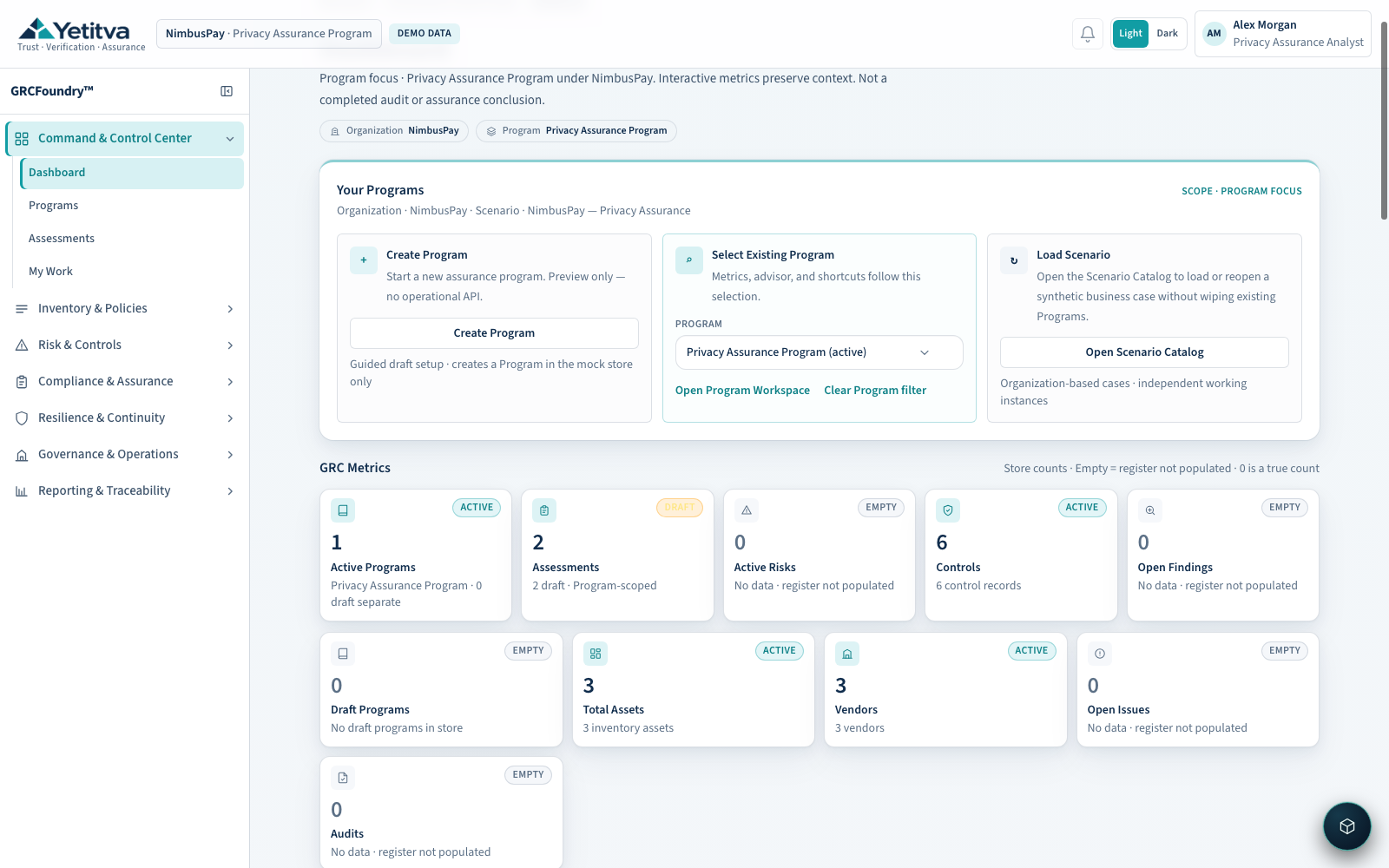
Product thesis. A modular GRC workbench where organizational context, risk, controls, mapping, assurance activity, and accountable decisions can be explored coherently — while mapping stays distinct from compliance proof, and Unknown stays visible.
Role. Independent product ownership across opportunity framing, strategy, requirements, information architecture, interaction design, prioritization, AI-assisted implementation collaboration, and iterative verification.
Evidence today. Implemented modular frontend with seven primary work areas; authentic Command Center, inventory, risk/controls, Unified Control Foundry™ Mapping, and TattvaCube™ screens; typed contracts and engineering checks. Hosted enterprise backend maturity, customer adoption, and live TattvaMap/TattvaGate services are not claimed.
Limitations. Working UI is not enterprise readiness. Website explanatory experiences for TattvaMap™ and TattvaGate™ are interactive concepts and product designs — not proof of operational product integration. RiskFlow remains a separate Yetitva initiative.
Selected product decisions
Judgment shown through concrete choices
High-value decisions rather than a generic skills grid. Each entry states the PM problem, the skill demonstrated, and the evidence class.
Connected governance workbench
Information architecture · product strategy
Governance disciplines stay distinct, but organizational records and relationships must remain understandable across workflows.
Implemented UIControl mapping distinct from assurance
Domain modeling · requirements honesty
Mapping coverage is easy to misread as proof that a requirement is satisfied. Mapping must stay reusable without becoming compliance theater.
Implemented UITattvaCube™ multidimensional exploration
Interaction design · progressive disclosure
A single status cannot answer every stakeholder question. Six dimensions keep concerns separable without inventing enterprise scores.
Implemented UITattvaMap™ relationship investigation
Concept design · uncertainty design
Organizations need to investigate dependencies without treating recorded links as causal proof.
Interactive ConceptTattvaGate™ agent governance
Solution framing · assurance workflow design
AI agents need boundaries, evaluation evidence, accountable authorization, and reassessment — not autonomous release theater.
Interactive Concept
Product management approach
How the work was actually done
Competencies shown through project decisions — not résumé abstractions.
Problem framing
Start from the decision the product must support, then identify which information must stay distinct so that decision remains defensible.
Stakeholder & workflow analysis
Map executive, program, owner, and operator needs as design hypotheses — never as invented interview findings.
Strategy & prioritization
Choose a modular workbench MVP that proves coherent navigation and honest empty states before live engines or intelligence theater.
Product & data modeling
Keep observation, finding, mapping, assurance, risk rating, and human decision as separate product concepts with explicit relationships.
UX & information architecture
Seven work areas, contextual orientation, and progressive exploration that preserve uncertainty instead of collapsing it into a score.
Implementation & evidence review
Collaborate with AI-assisted tooling under product ownership; verify claims with authentic screenshots, typed contracts, and engineering checks — not adoption metrics.
Clarity. Evidence. Assurance.
Continue the walkthrough
Use the case study for a 60–90 second introduction or a deeper 10-minute PM interview. Product and Solutions stay available for capability and challenge narratives.